
Engagement of Social Support Systems in Patients Being Considered for and Following Advanced Heart and Lung Surgical Therapies: An ISHLT Expert Consensus Statement
Published 23 September 2026
Colleen McIlvennan, PhD, DNP, ANP; Samantha Anthony, PhD, MSW; Fabienne Dobbels, MSc, PhD; Cassie Kennedy, MD, MS; Michael Petty, PhD, APRN; Melissa Sanchez, BSc, PGDip, MSc, DClinPsy; Martha Abshire Saylor, PhD, RN; Nancy Blumenthal, DNP, ACNP-BC; Khadijah Breathett, MD, MS; Malachy Clancy, PhD, OTR/L; Bernice Coleman, PhD, ACNP-BC; Melissa Cousino, PhD; Kavita Dave, FRCP; Hilary DuBrock, MD; Nathalie Duerinckx, RN, PhD; Meg Fregoso, MSN, ANP-BC; Kathleen Grady, PhD, MS, RN; Brittany Koons, PhD, RN; Christiane Kugler, PhD, FAAN; Angela Lorts, MD, MBA; Federica Meloni, MD, PhD; Desiree Robson, BSc(Hons), RN; Thomas Schlöglhofer, PhD, MSc; Andrew Morley Smith, MRCP PhD; Manu Varma, DO; Angela Velleca, MSHS, BSN, RN; Andrew Woods, BSc; and Jo Wray, PhD, C Psychol
J Heart Lung Transplant. September 2026.
Patients undergoing candidacy evaluation, awaiting surgery or recovering from advanced heart and lung surgical therapies, such as transplantation and left ventricular assist device (LVAD) implantation, face considerable physical, psychological, and social challenges. Social support systems, particularly caregivers, play a critical role in the care of these patients.
Despite the central role of caregivers and social support systems in transplantation and LVAD care, programs face ongoing challenges in how to assess, engage, and support these networks across the continuum of care. Definitions, assessment practices, and expectations for social support vary considerably across programs, and evidence guiding optimal caregiver engagement remains limited. Variability in patient needs, caregiver capacity, and health system resources further complicates the development of consistent approaches.
To address these challenges, a multidisciplinary group of international experts convened to develop this consensus statement to summarize the current evidence and clinical practices related to social support systems, including caregiver roles, for adult and pediatric patients undergoing evaluation, treatment, and recovery from advanced heart and lung surgical therapies. The statement also provides consensus-based recommendations to guide programs in systematically assessing social support, engaging caregivers, and implementing strategies to support both patients and caregivers to optimize adherence, recovery, and long-term outcomes following transplantation or LVAD implantation.
Read At JHLT
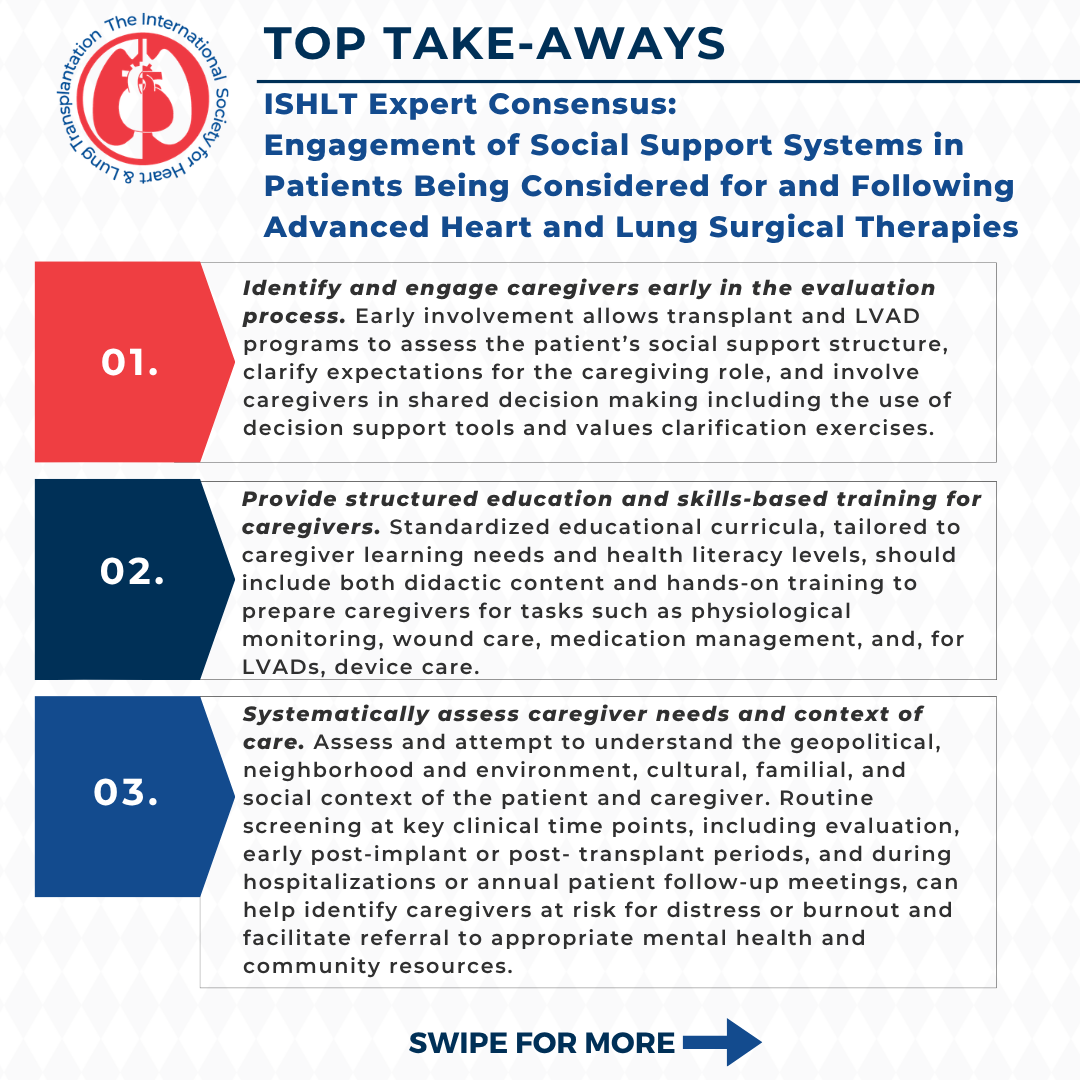
Top Takeaways
Click to view larger image and all top takeaways.
Related Guidlines
-
ISHLT Consensus Statement on Donor Organ Acceptability and Management in Pediatric Heart Transplantation
-
EPPVDN Expert Consensus Statement on the Diagnosis and Treatment of Paediatric Pulmonary Hypertension
-
ISHLT Consensus Statement on Short Telomere Syndrome and Lung Transplantation
-
Utilization of Hepatitis C Virus–Infected Organ Donors in Cardiothoracic Transplantation
-
Chronic Lung Allograft Dysfunction: Definition, Diagnostic Criteria, and Approaches to Treatment