

Assessing and Addressing Frailty in Candidates for Lung Transplantation: An ISHLT Consensus Statement
Published 20 August 2026
Michaela Anderson, MD, MS; Selim Arcasoy, MD, MPH; Christian Benden, MD, MBA, FCCP, FERS; Marie Budev, DO; Marlene Cano, MD, PhD; Kam Man Larissa Chandra, MHLM, BAppSc (Occupational Therapy); Malachy Clancy, PhD, OTR/L; Joshua Diamond, MD, MSC; Ioannis Dimarakis, MD, PhD; Alexander Dragnich, MD; Louise Fuller, PhD, BAppSci (Physio); Vasiliki Gerovasili, MD; Laurent Godinas, MD; Zubair Hashmi, MD; Are Holm, MD, PhD; Brittany Koons, PhD, RN; Zsofia Kovacs, MD; Jin Gu Lee, MD; Erin Lowery, MD, MS; Julia Maheshwari, MD; Federica Meloni, MD; Elyn Montgomery, PhD, RN; Catherine Meyers, MD; Justin Rosenheck, DO; Aman Sidhu, MD; Lianne Singer, MD, FRCPC; Laurie Snyder, MD, MHS; Syed Tousheed, MD; Rhea Varughese, MD, MS; James Walsh, BPhty, PhD; Barbara Wilkey, MD; Monique Malouf, MBBS, FRACP; Jonathan Singer, MD, MS
J Heart Lung Transplant. August 2026.
NEW JHLT: The Podcast Episode
Featuring a discussion of the consensus statement findings and takeaways.
Frailty is a multidimensional syndrome of decreased physiological reserve and resilience that increases vulnerability to stressors such as major surgery, and is an increasingly important consideration in lung transplantation due to changing candidate profiles. Extensive research has established frailty as a risk factor for adverse outcomes such as disability, death, and delisting before transplantation, as well as prolonged hospitalization, discharge to rehabilitation, and death after transplant.
Valid, informative, standardized frailty assessments can help set patient and caregiver expectations, facilitate listing decisions, identify candidates who would benefit from targeted intervention, assess program performance, and inform institutional resource planning. However, practical guidance on how to integrate these assessments into clinical practice has been lacking.
This consensus statement offers practical recommendations on how to select a fit-for-purpose frailty measure, assess timing, and manage the frailty syndrome. The statement highlights that several frailty measures validated for use in lung transplantation are available to aid programmatic and clinical decisions in the evaluation of lung transplant candidacy. The statement also highlights key knowledge gaps, including the need to validate measures of frailty in critical illness, develop methods to reliably identify candidates whose frailty will reverse post-transplant, and establish pediatric-specific frailty measures.
Read at JHLT
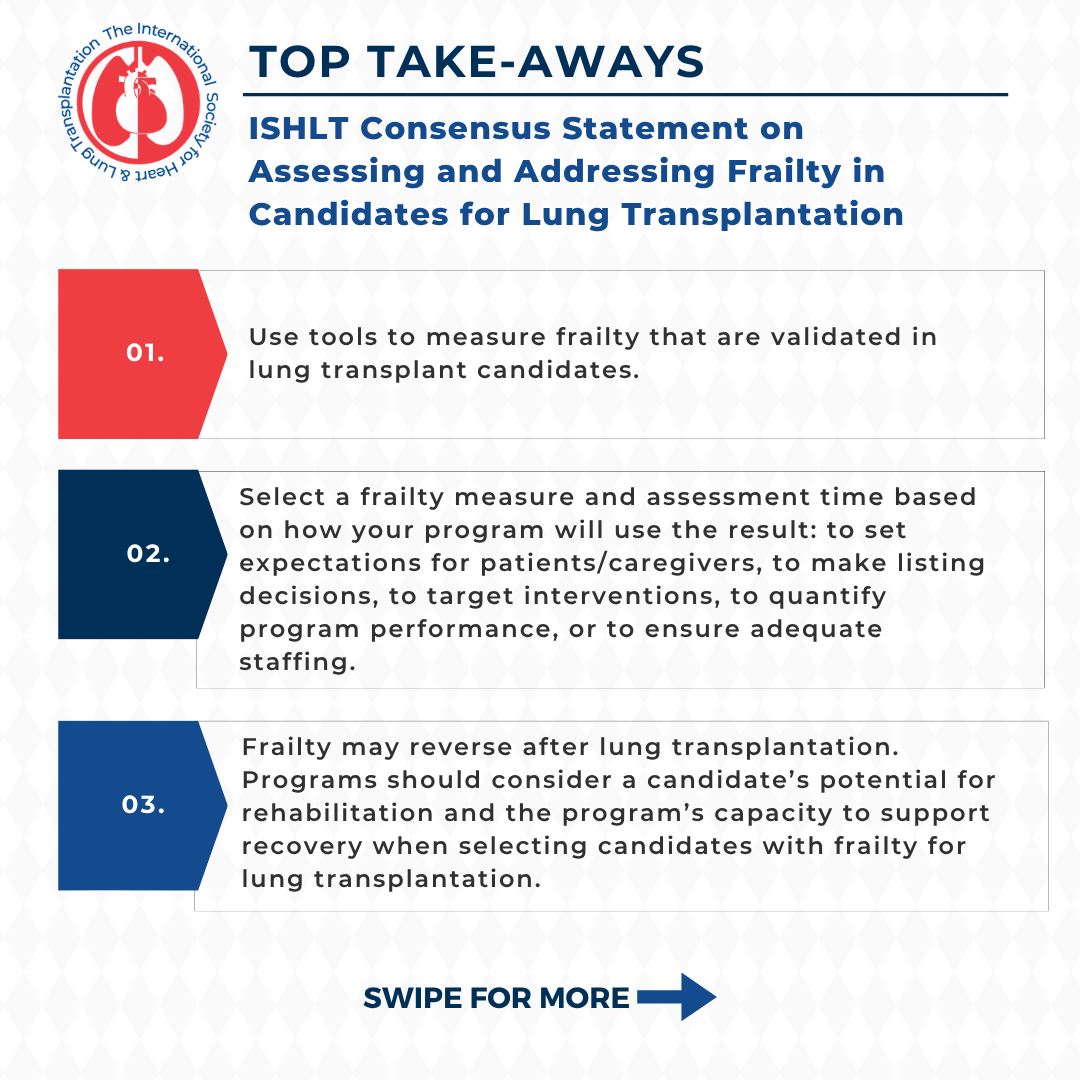
Top Takeaways
Click to view larger image and all top takeaways.
Related Guidlines
-
2009 ESC/ERS Guidelines for the Diagnosis and Treatment of Pulmonary Hypertension
-
EPPVDN Expert Consensus Statement on the Diagnosis and Treatment of Paediatric Pulmonary Hypertension
-
ISHLT Consensus Statement on Donor Organ Acceptability and Management in Pediatric Heart Transplantation
-
Destination Mechanical Circulatory Support: Proposal for Clinical Standards
-
Chronic Lung Allograft Dysfunction: Definition, Diagnostic Criteria, and Approaches to Treatment