

Baseline Lung Allograft Dysfunction: Definition, Timing, and Implications for Outcomes—An ISHLT Consensus Document
Published 11 August 2026
Jens Gottlieb, MD; Tereza Martinu, MD, MHS; Merel Hellemons, MD, PhD; David Darley, MBBS, BSc, PhD; Laurie Snyder, MD, MHS; Laura DiChiacchio, MD, PhD; Miranda Paraskeva, MBBS, MPH; Christian Benden, MD, MBA; Berta Saez-Gimenez, MD, PhD; Anoop Mohandas, MD, DNB, FNB, DESA; Letizia Corinna Morlacchi, MD; Joshua Diamond, MD, MSCE; Saskia Bos, MD, PhD; Erika Lease, MD; Geert Verleden, MD, PhD; Allan Glanville, MBBS, MD, FRACP; Kieran Halloran, MD, MSc
J Heart Lung Transplant. August 2026.
NEW JHLT: The Podcast Episode
Featuring a discussion of the consensus statement findings and takeaways.
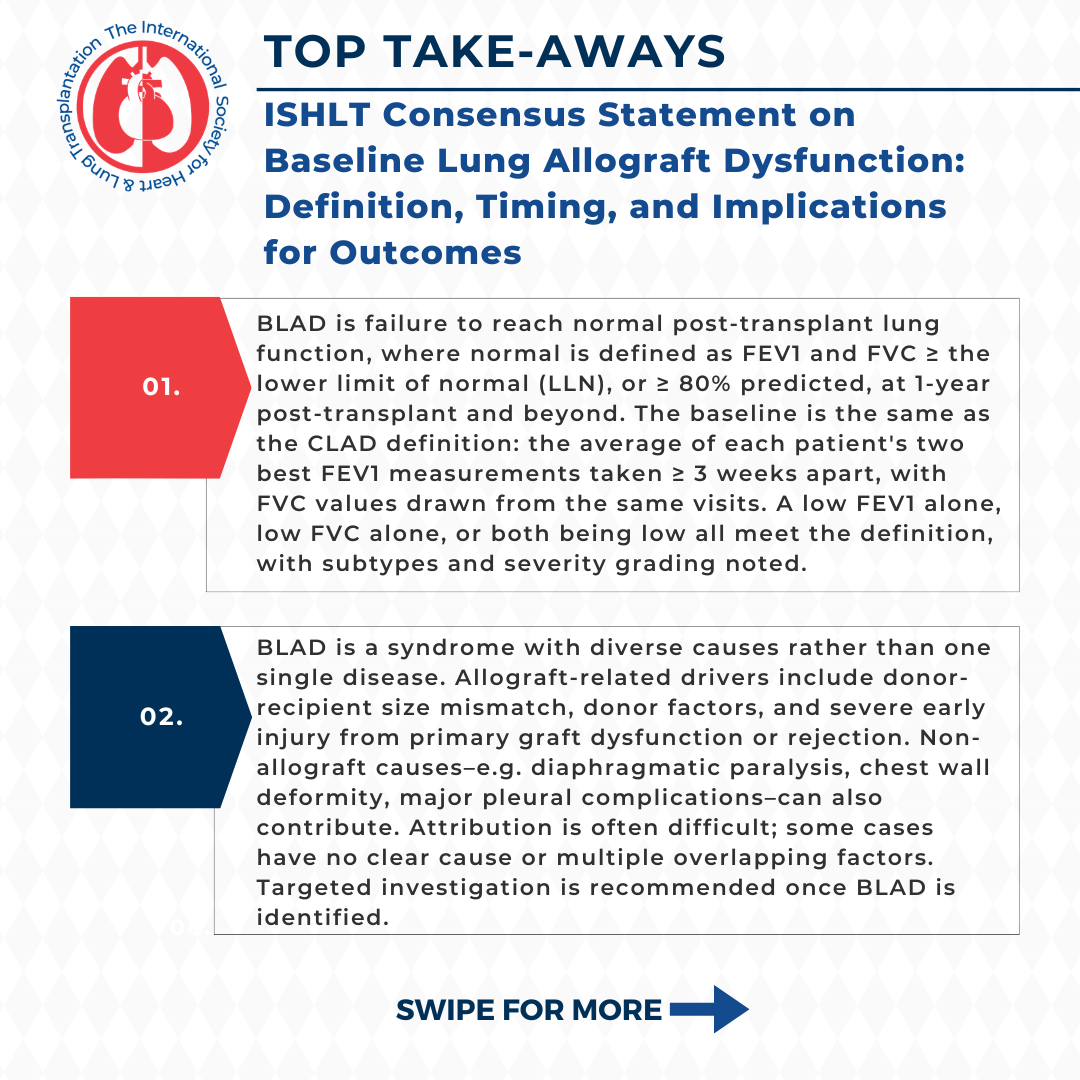
Lung allograft dysfunction after transplant is a major cause of mortality and morbidity in lung transplant recipients and poses a significant barrier to improving long-term survival and quality of life. While the constructs for acute lung allograft dysfunction (ALAD) and chronic lung allograft dysfunction (CLAD) capture declines in lung function, they do not address patients with subnormal but stable baseline function. This physiologic state–termed baseline lung allograft dysfunction (BLAD) – has been linked to impaired survival, though definitions in the literature have varied. The BLAD concept has also generated important discussions about whether it creates unrealistic expectations of normal post-transplant lung function.
The role of this consensus document is to clearly define the utility of the BLAD construct, to standardize the definition for future clinical and research use, and to summarize what is known about its potential risk factors, causes, and association with outcomes.
Read at JHLT
Top Takeaways
Click to view larger image and all top takeaways.
Related Guidlines
-
Generic Drug Immunosuppression in Thoracic Transplantation
-
The 2015 ISHLT Guidelines for the Management of Fungal Infections in Mechanical Circulatory Support and Cardiothoracic Organ Transplant Recipients: Executive Summary
-
Implementation Framework for the ISHLT Statement on Transplant Ethics
-
Assessing and Addressing Frailty in Candidates for Lung Transplantation: An ISHLT Consensus Statement
-
The 2016 ISHLT Listing Criteria for Heart Transplantation: A 10-year Update