

ISHLT Consensus Statement on Risk Stratification in Pulmonary Arterial Hypertension
Published 5 September 2025
Sandeep Sahay, MD, MSc; Scott Visovatti, MD; Adriano Tonelli; Nelson Villasmil Hernandez, MD; Eric Austin, MD, MSCI; Roberto Badagliacca, MD, PhD; Rolf Berger, MD, PhD; Athénaïs Boucly, MD; Yucheng Chen, MD; Colin Church, BSC(Hons), PhD, FRCP; Marion Delcroix, MD, PhD; Allen Everett, MD; Harrison Farber, MD; Charles Fauvel, MD; Mardi Gomberg-Maitland, MD, MSc; Megan Griffiths, MD; Francois Haddad, MD; Yuchi Han, MD; Anna Hemnes, MD; Marius Hoeper, MD; Manreet Kanwar, MD; Daniel Lachant, DO; Sandhya Murthy, MD; Karen Olsson, MD; Ioana Preston, MD; Göran Rådegran, MD; Olivier Sitbon, MD; Maria Trivieri, MD, PhD; Jean-Luc Vachiery, MD; Rebecca Vanderpool, PhD; Jason Weatherald, MD, MSc, FRCPC; R. James White, MD; Helen Whitford, MBBS, FRACP; Melisa Wilson, DNP, MSN, APRN; and Raymond Benza, MD.
J Heart Lung Transplant. September 2025.
Pulmonary arterial hypertension (PAH) is a rare, progressive disorder characterized by vascular remodeling and increased pulmonary vascular resistance, ultimately leading to right heart failure and premature death. Given the serious and life-limiting nature of the disease, accurate risk stratification is essential to guide therapeutic decision-making, identify patients at increased risk for clinical deterioration or mortality, and inform prognostic discussions.
In order to improve the understanding and utilization of risk stratification tools in the real world practice, experts worked for several years to develop a document to provide clinicians with a practical framework for the application of risk stratification systems in routine clinical practice along with future directions, thereby promoting evidence-based management and supporting efforts to improve patient outcomes.
This consensus statement on risk stratification in PAH integrates emerging evidence, contemporary clinical practice, and advancements since prior frameworks were established, and emphasizes that risk assessment should complement, rather than replace, clinical judgment. Additionally, it highlights the importance of multidisciplinary collaboration, patient-centered care models, and systematic efforts to refine and expand the evidence base.
Read at JHLTRead the Perspective Piece at JHLT Download the Perspective Piece
The ISHLT Perspective Piece is a new document type developed to accompany all ISHLT Documents and is specifically designed for print publication in JHLT. The piece The piece will set the context for the document in an easy-to-read manner and serves as an opportunity for writing groups to speak directly to the heart and lung transplant community about the rationale behind each document, its most important takeaways, and the hard work that went into creating it.
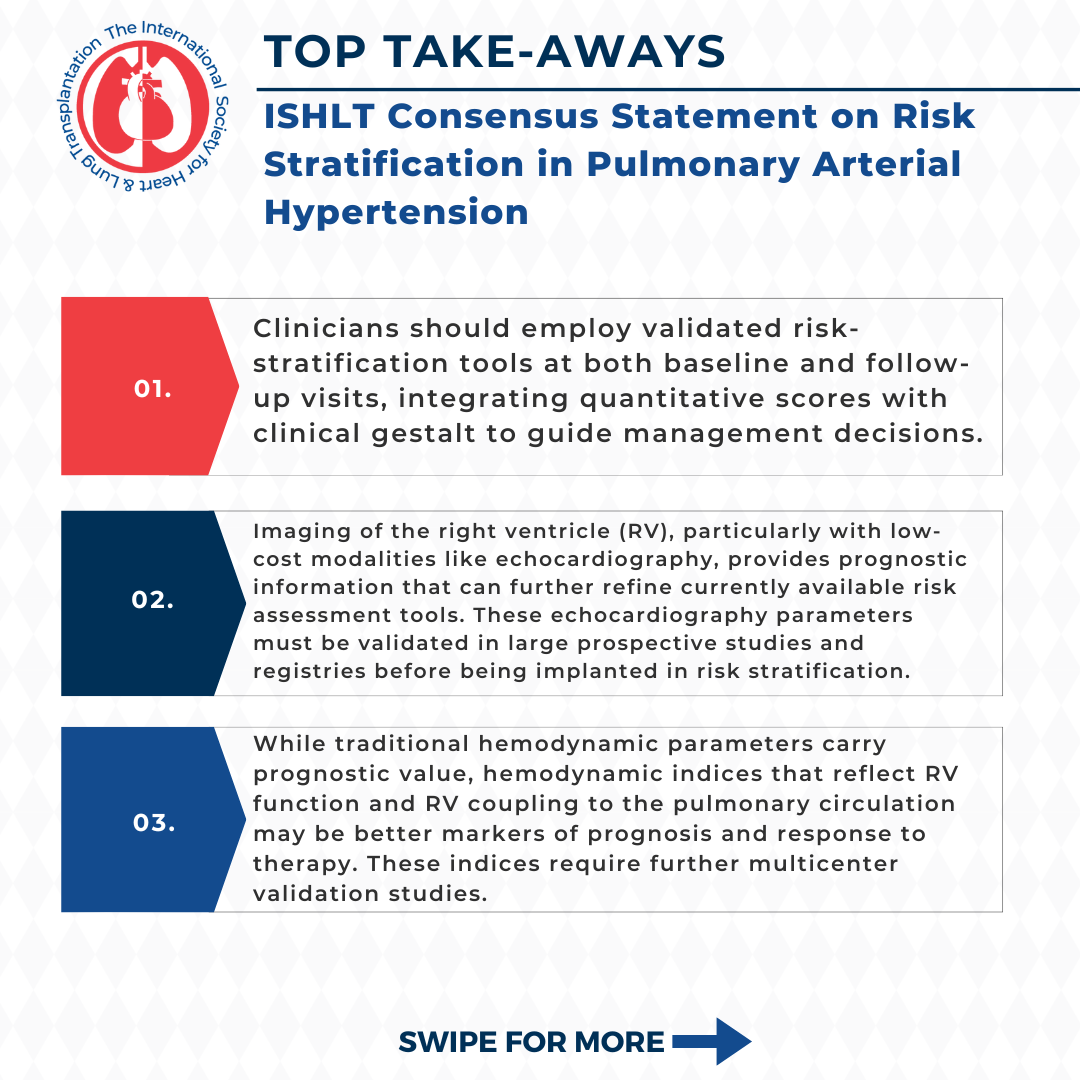
Top Takeaways
Click to view larger image and all top takeaways.
Related Guidlines
-
ISHLT Statement on Vaccines in Transplant Recipients
-
ISHLT Consensus Statement for the Standardization of Bronchoalveolar Lavage in Lung Transplantation
-
2019 Updated Consensus Statement on the Diagnosis and Treatment of Pediatric Pulmonary Hypertension
-
A 2010 Working Formulation for the Standardization of Definitions of Infections in Cardiothoracic Transplant Recipients
-
EPPVDN Expert Consensus Statement on the Diagnosis and Treatment of Paediatric Pulmonary Hypertension